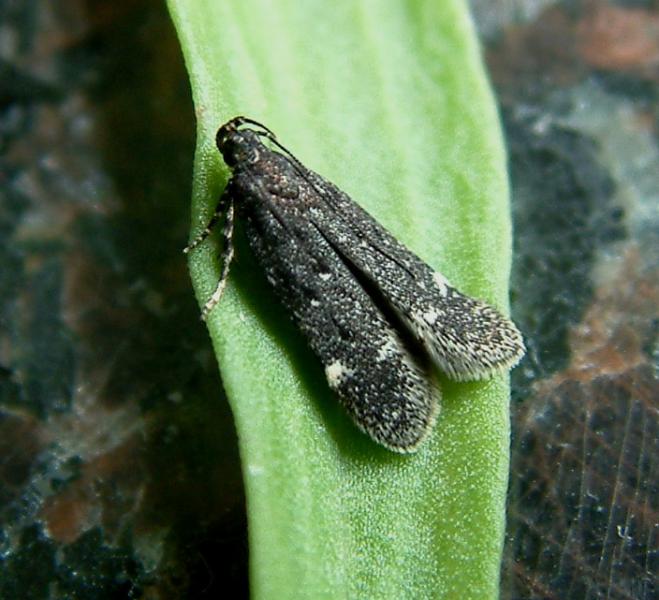
Neofriseria peliella and N. singula are very similar with just enough variation in the wing markings to allow the identification of reasonably fresh specimens. The genitalia are also similar and the easiest way to separate the two is by the colour of the larva (see below).
N. peliella has the lower of the two black spots at two-fifths on the forewing usually slightly basad of the upper. The forewing colour is blackish fuscous with the base of the scales greyish giving a slightly mottled appearance. In N. singula the spots at two-fifths are directly one above the other and the forewing colour is greyish fuscous with a variable ammount of dusting of dull yellowish-white scales. N. singula is slightly smaller on average (13-15mm wingspan) than N. peliella (13-16mm) but there is considerable overlap.
The frons (front of the face) is pale ochreous at the base and greyish brown above in N. peliella with the vertex (top of the head) dark fuscous to blackish. In N. singula the frons is dull to greyish white, darker above with the vertex mixed whitish and blackish brown.
Genitalia differences are only discernable in the males, with that of N. peliella being broader in the uncus, having a stouter harpe and a more evenly tapering tip to the aedeagus.
The larvae are distinctive with the body of N. peliella being chocolate-brown and that of N. singula pale dull green; both have black heads and prothoracic plates. It should be noted that the larva of Aroga velocella and Teleiopsis diffinis both feed on sheep's sorrel in silken tubes near the base of the stem.
Studies at a locality in Denmark, where both species occur at the same site, have supported the specific distinctness as each is attracted to a different pheromone.