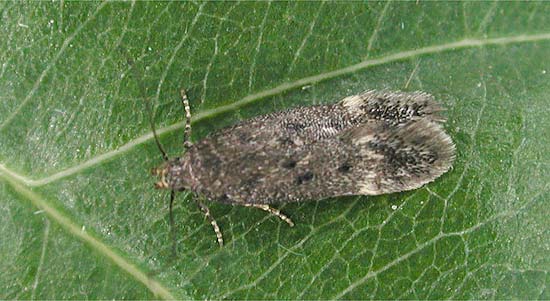
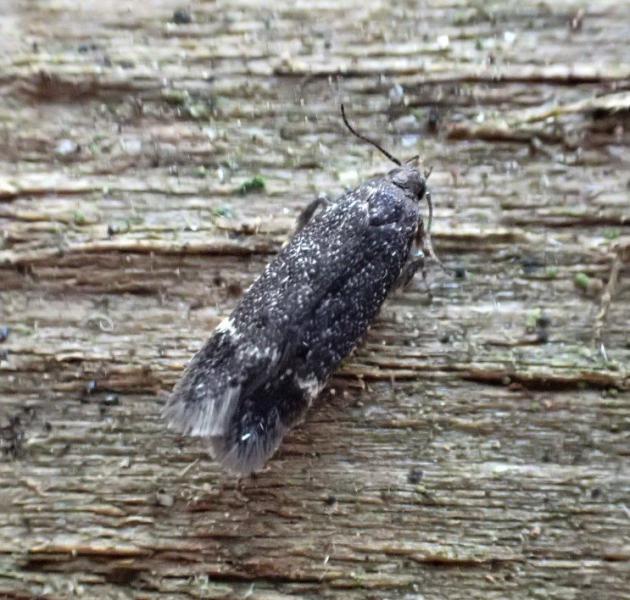
Rather variable, with the forewing ranging from pale greyish-brown with the creamy-yellow costal and tornal spots (where the black discal spots stand out), to an all-over dark, slightly glossy, blackish-brown colour where the discal spots are difficult or impossible to discern. The absence of conspicuous scattered light scales beyond one third distinguish this species from B. affinis (the only pale scales in this part of the wing in B. similis being the tornal and costal spots, if present). The dark form of B. umbrosella is a strong black colour lacking any hints of brown or grey. In very dark forms of B. senectella the head often has ochreous cheeks contrasting with the grey-brown vertex, when viewed from above looking like a dark line extending over the middle of the head. In B. similis, the vertex is glossy dark grey-brown, lower frons creamy-yellow to yellow-grey and the cheeks dark yellow-grey to dark grey-brown. To see the latter feature in some specimens it is necessary to look at the face from slightly below. When at all worn or if there is any doubt, dissection is recommended.
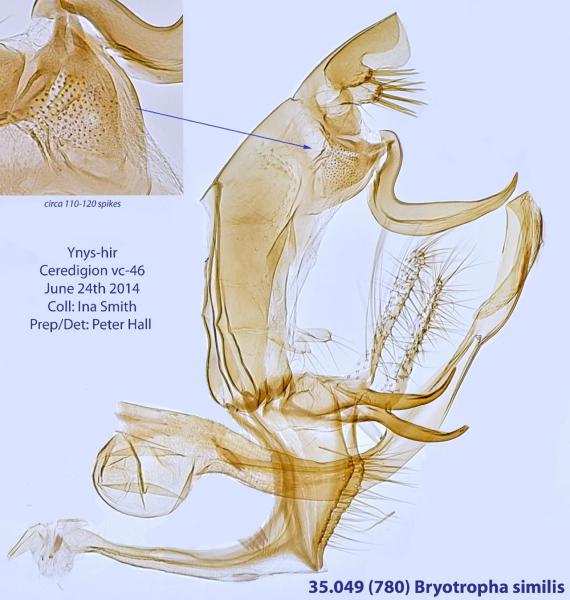
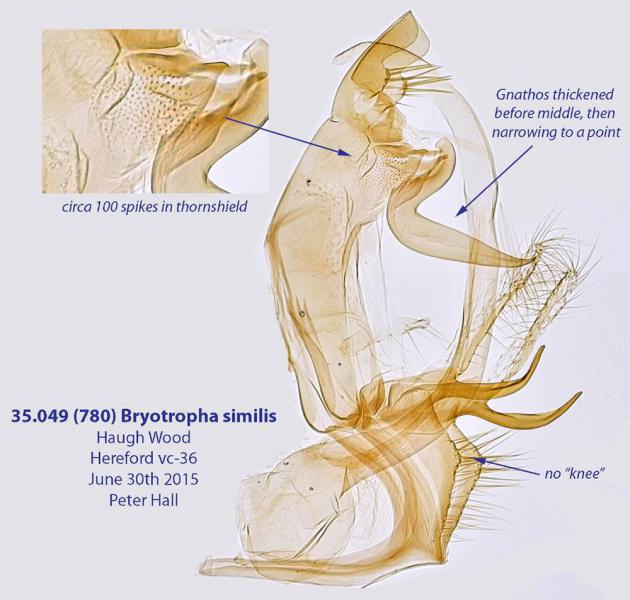
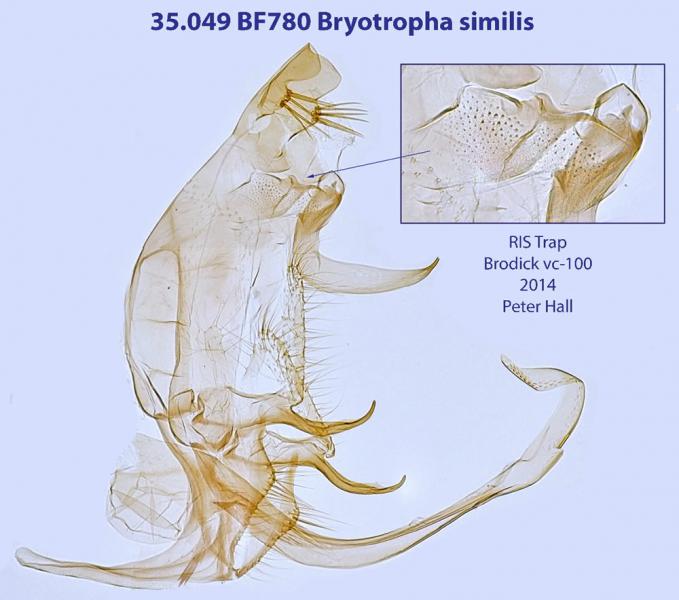
Male Genitalia differences - the lack of any obvious protrusion on the 'knee' (which is also lower down the saccus) in B. similis as compared to the slight protrusion in B. affinis and more obvious outward bulge in B. senectella is a good identification feature. It is particularly useful when encountering the occasional specimen where the gnathos can have a more slender and elongated shape as is found in B. affinis.